Cornhole League - Board Games
- 4.3
- Rating
- 10.00M
- Installs
- Free
- Price

 Analysis by App-foxy
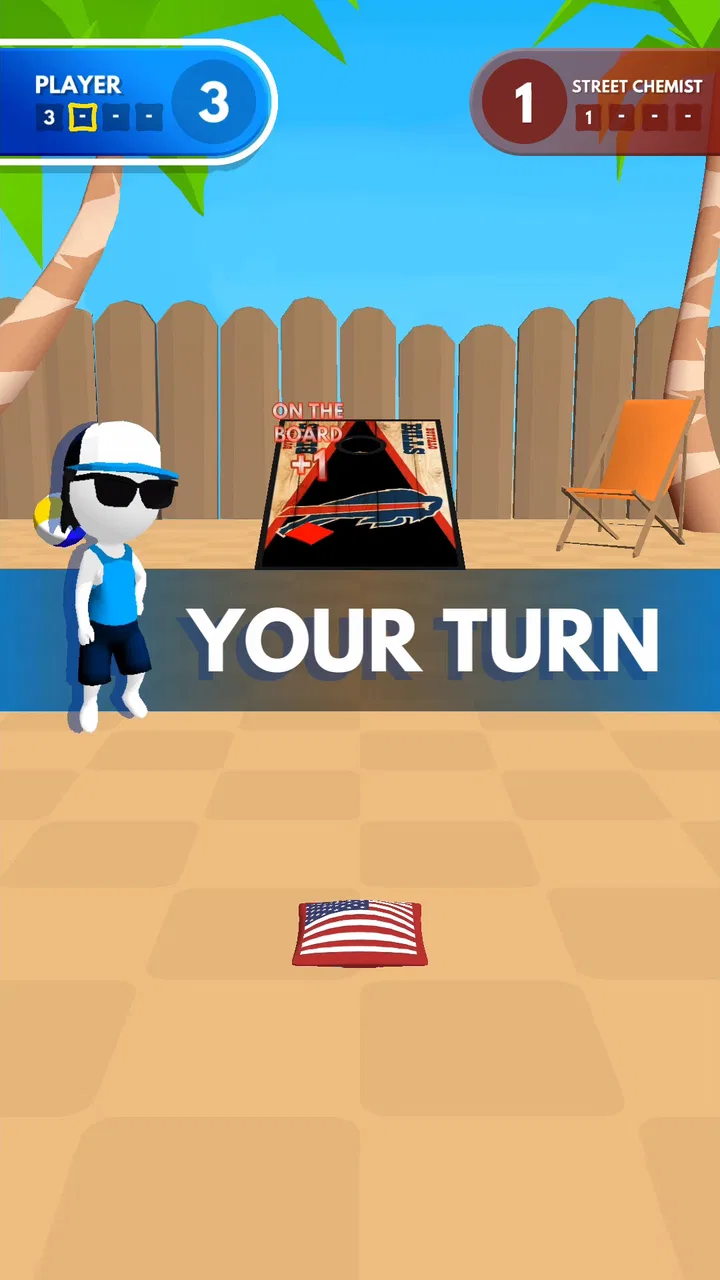
I spent time with Cornhole League as a casual sports game, paying particular attention to how comfortably it works in different situations and for different kinds of players. Its basic idea is easy to understand: aim beanbags at a raised board and score by landing them on it or sending them through the hole. That simplicity makes it approachable, but the game still has enough timing and aiming pressure to keep a short session from feeling completely empty.
Developed by TapNation, this free game sits in the sports category and is suitable for Everyone. It has reached over ten million installs, with an average rating of 4.3 from around forty-seven thousand ratings. Those numbers suggest that it has found a broad audience, and I can see why: it turns a familiar outdoor pastime into something I can play when I do not have a garden, a physical board, or another person nearby.
My overall impression is positive, though I would not describe it as a perfect substitute for real cornhole. The appeal is strongest when I want a quick, low-commitment game with simple controls. The weaknesses become more noticeable when I want deep strategy, a highly social experience, or a very calm interface with no interruptions. The most useful question is not whether it is universally good, but whether its particular style fits the way you want to play.
You May Also Like

 Google Keep - Notes and lists
Google Keep’s Quiet Growth Shows the Appeal of Simpler Notes
As mobile work gets busier, Google Keep keeps winning a simple contest: capture a thought quickly, find it later, and get on with the day.

 Blood Strike: 2.5 Anniversary
Blood Strike’s Loadouts Turn Every Drop Into a Tactical Gamble
A close look at Blood Strike’s custom loadouts: how fast access to signature weapons reshapes its battle royale rhythm, rewards preparation, and narrows the gap between fights.

 Pandora - Music & Podcasts
Pandora’s Music Is Easy to Start, but Harder to Recover
Pandora’s strength is its low-effort path from a seed to a station. Its weak spot is how much confidence it asks you to place in connection, setup, and quiet recovery.

 8 Ball Pool
 Is Built on Rivalries, Rematches, and Routine
A close look at the rivalries, rematches, shared routines, and unanswered safety questions that turn a quick pool match into a persistent mobile community.

 Samsung Music
’s Quiet Strength Is Playing What You Already Own
Its reach comes less from spectacle than from dependable access to a personal library. That simplicity is both the app’s strongest retention engine and its ceiling.

 AccuWeather: Weather Radar
AccuWeather Review: A Quick, Clear Forecast for Everyday Decisions
For everyday plans, the best forecast is the one you can understand quickly. AccuWeather makes rain timing, radar, and local conditions easy to act on, with a few trade-offs.
More From Our News Desk



How clearly the game communicates what to do
I find that the game’s clearest strength is how quickly it explains its central task: line up a beanbag with the board and make each throw count. That keeps the learning curve light, while still leaving room to pay attention to aim and timing. In the next section, I’ll look at how that straightforward idea translates into actual play and what can make a session feel more or less comfortable.
Readable rules and a gentle starting point
The central action is immediately understandable. I do not need to learn a large rulebook before trying a throw, and the familiar board-and-bag setup gives the game a useful visual anchor. That matters for younger players, occasional players, and anyone who does not normally spend time with sports games. The game’s concept is much easier to grasp than a title built around several buttons, character abilities, or complicated scoring screens.
There is also a practical benefit to the narrow focus. I can pick it up after a long break and remember what I am trying to do without relearning a control scheme. For a family sharing a phone or tablet, that makes it less intimidating than many competitive sports games. A child can understand the goal quickly, while an adult can still look for better angles and more reliable throws.
At the same time, simple rules do not automatically mean perfect clarity. The important information during a turn is concentrated around the board, the throw, and the result. If you are easily distracted by movement or by changes on the screen, the pace may feel busier than the underlying game deserves. I found it helpful to slow down mentally before each attempt rather than treating every throw as something to rush through.
Navigation that favors short sessions
The game is best approached as a pick-up-and-play experience. I can imagine opening it while waiting for an appointment, taking a few turns during a break, and putting it away without feeling that I have abandoned a long task. That short-session quality is one of its clearest strengths.
It also makes the game suitable for people who do not want to manage a large amount of information. Compared with a full sports simulation, there is less to memorize and less preparation before the action. Compared with a physical board, there is no need to set up equipment, measure a throwing distance, or retrieve bags after every round.
My advice is to treat the opening moments as a learning period rather than judging your ability from the first few throws. The feel of a digital throw is different from tossing a real bag. Small changes in timing or direction can matter, and the most useful early goal is to understand how the game responds to your input. Once that becomes familiar, the matches feel more deliberate.
What the numbers tell me, and what they do not
The game is free to download, which makes trying it low risk. It includes in-app purchases ranging from $0.99 to $32.99 per item, so I would still approach it with the same spending caution I use for any free-to-play game. A free entry point is helpful for families, but it does not mean every part of the experience is equally free from purchase prompts or optional spending.
The current version is 1.23.0, and it runs on Android 7.0 or later. That gives it a reasonably broad device range for people using older Android phones, although actual comfort will still depend on screen size, performance, and how well the device responds to touch. Before installing it on a shared or older phone, I would check that there is enough storage and that the operating system meets the requirement.
Why the interface matters for different players
For me, the strongest readability feature is the concrete visual target. A board and a bag are easier to interpret than an abstract collection of icons. That can help players who prefer visual learning or who want to understand a game by watching one action before committing to a long tutorial.
However, visual simplicity should not be confused with universal accessibility. A player with low vision may find aiming and judging the target difficult, especially on a small phone. Someone who relies on a screen reader should not assume that every visual element will be equally understandable. I would test the game on the intended device rather than promising that its straightforward concept will solve every navigation need.
Motor control, sensory comfort, and playing in real situations
I’m focusing here on the practical demands that remain once the rules are clear: steady touch input, a screen you can see comfortably, and a setting where you can give a throw your attention. Those details can shape the experience as much as the simple premise does. They also help explain why the game suits some breaks and players better than others.
Why the controls can be approachable
Cornhole League does not ask me to coordinate a large collection of buttons at once. The main challenge is focused on directing a throw, which can feel more manageable for players who dislike fast action games. There is no need to remember a long sequence of combat commands or switch between several tools during a single moment.
That does not mean the game is effortless for every motor profile. Precision aiming still requires controlled touch input, and a player with tremors, limited dexterity, or difficulty with small gestures may find consistent throws frustrating. A larger screen could make the target easier to see and interact with, while a small phone may demand more accuracy than some players can comfortably provide.
One useful approach is to hold the device in a stable position instead of playing one-handed while walking or carrying something. I get more consistent results when the phone is supported and my other hand is free to make a controlled input. This is a small change, but it separates the game’s aiming challenge from unnecessary physical wobble.
Different abilities call for different expectations
For players with limited mobility, the digital format removes the need to stand, bend, carry a board, or retrieve bags. That is a genuine advantage over outdoor cornhole. Someone who enjoys the rules and scoring but cannot comfortably participate in the physical version may find the mobile format more practical.
There is a trade-off, though. The app replaces large, physical objects with a small touch surface. Players who find broad real-world movements easier than precise finger control may prefer an actual board, especially if they can adapt the throwing distance or use physical assistance. In that situation, the mobile version is not automatically the more accessible option; it simply changes which abilities matter most.
Sensory comfort is another personal issue. Sports games often use motion, sound, and visual feedback to make successful actions feel satisfying. That can help explain what happened after a throw, but it may be tiring for players who are sensitive to movement, sudden effects, or repeated audio cues. I recommend beginning with a short session in a quiet environment and checking whether the presentation feels energizing or distracting before settling in for longer play.
When the game works especially well
The best everyday use case I found is a short break where I want something more interactive than scrolling but less demanding than a full match-based game. It can also work during a family visit when people want to compare attempts on one device without arranging outdoor equipment. The rules are familiar enough that someone can watch a turn and understand the result quickly.
It is also a reasonable option for a player who enjoys casual competition but does not want real-time pressure from strangers. A slower, turn-focused activity gives me time to think about the next throw. That makes it more comfortable than many online sports games for someone who dislikes rapid reactions or public mistakes.
On the other hand, I would skip it when I need a game that can be played entirely by sound, when I am looking for a strong cooperative experience, or when I want a detailed simulation of real throwing technique. Its appeal depends on seeing the board and interacting with the throw, so it is not a good match for every sensory or input preference.
How it compares with physical cornhole
The physical game wins on social presence. Real cornhole gives players a reason to stand together, talk between throws, adjust the distance, and enjoy the atmosphere of an outdoor gathering. It also provides a larger target and a more natural sense of movement. No mobile game can fully reproduce the feel of a bag leaving your hand or the small celebration when a difficult shot lands.
The app wins on convenience. I do not need storage space, a flat outdoor area, suitable weather, or a partner who is available at the same time. It is also more practical for someone who cannot comfortably stand or move around a physical setup. In that sense, it is not merely a weaker physical imitation; it is a portable alternative with a different purpose.
Compared with larger sports simulations, this game is less intimidating and faster to understand. The cost of that simplicity is depth. Players who want team management, realistic seasons, extensive customization, or a wide collection of sports should look elsewhere. Cornhole League is focused, and that focus is either its main strength or its main limitation depending on what you expect.
Remaining barriers before you recommend it
The first barrier is screen-based precision. Even though the rules are easy, accurate throws may not be equally easy for every player. A person with reduced fine motor control should try the game before committing to long sessions, ideally on a device with a comfortable display and responsive touch surface.
The second is the free-to-play structure. Optional purchases can be useful for players who want to spend, but they can also make a family device less comfortable if children are playing without clear spending boundaries. I would use the platform’s purchase controls and agree on expectations before handing the game to a child. The Everyone age rating describes the intended content level, not a guarantee that every family will be comfortable with its commercial design.
The third is attention demand. A player may understand the rules but still struggle if the screen is visually busy, if interruptions break concentration, or if the pace feels too quick. It is worth playing in a stable seated position and avoiding the game while moving through a busy place. That is both safer and more useful for judging whether the controls genuinely suit you.
There is also a social limitation. The app can recreate the act of taking turns, but it cannot automatically provide the conversation and shared physical space that make outdoor cornhole enjoyable. If your main goal is a party activity, a real board or a multiplayer title built around direct social interaction may be a better choice.
Who should install it
I would recommend it to casual sports fans, families looking for a simple turn-based activity, and players who enjoy aiming games without a complicated ruleset. It is particularly appealing if you like the idea of cornhole but lack the room, equipment, mobility, or weather for the physical version.
I would be more cautious about recommending it to people who need strong non-visual interaction, dislike touch precision, or want a deep competitive system that rewards long-term study. I would also avoid presenting it as a complete replacement for playing with friends outdoors. It is better understood as a convenient digital interpretation for short sessions.
My inclusive verdict
After using it, I see Cornhole League as an approachable sports game whose accessibility comes mainly from its focused idea and modest control demands. It removes several physical barriers associated with real cornhole, but it introduces others through screen size, touch accuracy, visual attention, and the realities of free-to-play design.
The most important trade-off is simple: the app makes cornhole easier to access physically, but not necessarily easier for every kind of touch or visual need. That is why I would recommend trying it on the actual device and in the actual setting where it will be played. A large tablet in a quiet room may feel comfortable; a small phone used one-handed in a noisy place may not.
TapNation’s game earns its place as a convenient casual sports option because it gets to the throwing idea quickly and avoids the heavy complexity of traditional sports simulations. I enjoyed it most in brief sessions, when I wanted a focused challenge rather than a complete recreation of an outdoor event. If that is what you want, the free download makes it easy to test. If you are seeking deep strategy, robust social play, or guaranteed comfort for a particular accessibility need, choose with more care and compare it with the physical game or a more specialized alternative.
FAQs for Cornhole League - Board Games
01What is Cornhole League - Board Games about?
Cornhole League - Board Games is a digital adaptation of the popular outdoor game, Cornhole. Players can enjoy a realistic cornhole experience with lifelike graphics, various boards, and customizable bags. The game features solo and multiplayer modes, allowing users to compete against friends or AI opponents.
02Is Cornhole League - Board Games free to play?
Cornhole League - Board Games offers a free-to-play model with optional in-app purchases. While you can enjoy many features without spending money, certain boards, bags, and cosmetic upgrades may require purchasing with real money. This allows for a personalized experience while supporting the developers.
03What devices are compatible with Cornhole League - Board Games?
Cornhole League - Board Games is available on both Android and iOS platforms. The game requires an updated operating system for optimal performance. Check the app store for specific OS version requirements to ensure compatibility with your device before downloading.
04Does Cornhole League - Board Games require an internet connection?
Cornhole League - Board Games can be enjoyed offline in single-player mode, allowing you to practice or play against AI without an internet connection. However, to access multiplayer features, leaderboards, and updates, an internet connection is necessary. This enhances the social gaming experience.
05Are there any social features in Cornhole League - Board Games?
Yes, Cornhole League - Board Games includes social features that allow players to connect with friends and compete in online tournaments. You can invite friends for matches, share your achievements, and see how you rank on the global leaderboards, adding a competitive edge to the game.
Pros
- Smooth and intuitive gameplay mechanics.
- Wide variety of boards and bags.
- Multiplayer features enhance competitiveness.
- Regular updates with new challenges.
- Minimal ads ensure uninterrupted play.
Cons
- Requires constant internet connection.
- Limited offline game modes available.
- In-app purchases can be costly.
- Occasional lag in online matches.
- Lacks customization for avatars.

Cornhole League - Board Games
Gallery